Abbey Meadows

Abbey Meadows

Monday, 10 May 2010

Windy Gyle


Whinchat on the upper Coquet at Windyhaugh


Dipper on the Rowhope burn

One of the feral goats at Mozie Law


A view of the Hen hole from Windy Gyle


A Raven in Scotland on the wrong side of the Border fence!


The Rowhope burn


The path to the summit

I went for a long walk into the Coquet valley leaving the car at Rowhope then up the Street to the Border fence. I headed South west to Mozie Law as far as Beefstand hill then back along the Pennine way heading North East up to Windy Gyle. From this lofty position you get the best views from any of the Cheviot peaks. Very cold and breezy up here but very nice. Not much wildlife up here but I did see Buzzards and at least four Ravens. Caught up with the nomadic Goat herd at Mozie Law with Kids in tow. A single Golden Plover and dozens of Red Grouse between Mozie Law and Beefstand hill.

I returned by the Trow burn and began to see more birds at the lower levels. On the upper Coquet there were a few Common Sandpipers and at least 500 Swallows, this is where all the feeding must have been and as I watched them I noticed a small bird feeding in the middle of the water from a rock. Probably Britains finest bird species...Whinchat...the highlight of the day! Unusually I thought, was a Swift feeding near the summit of windy Gyle.

Saturday, 8 May 2010

Northumberland's county flower!


Herb paris...Cottingwood.

The county flower of Northumberland is Bloody Cranesbill (Geranium sanguineum). A good choice, it is a beautiful plant and its flowers brighten up the coastal dunes throughout the Summer months. However, I personally believe that Northumberland's county flower should have been Herb Paris (Paris quadrifolia). Two main reasons, the first being it was discovered by the 16th century botanist William Turner who lived in Morpeth and at that time it was a flower new to Britain...'Libardbayne or one bery...in a wodde beyside Morpeth called Cottingewood'. (Turner 1548). The second reason was that to this day the plant can still be found growing in the very spot Turner discovered it. It is a poisonous plant and it was also known as Herb truelove. Turner discovered several new species including Great Broomerape and other great Northumberland botanists discovered plants new to Britain from the county such as Spignel, Seaside Centaury and Dwarf Cornel. True explorers and pioneers!

Sunday, 2 May 2010

Borough Woods and Longwitton Dene

Barren Strawberry (Potentilla sterilis)...Longwitton Dene

Hazel Bracket (skeletocutis nivea)

Slime mould (Reticularia lycaperon)...Borough woods


Possibly a different stage of the above


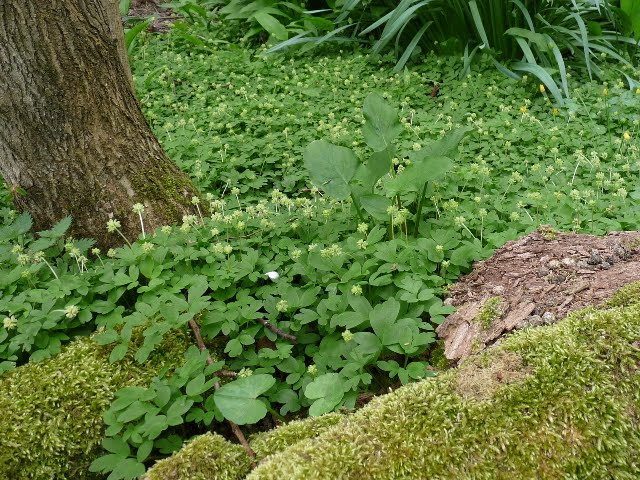
A carpet of Moschatel in the Borough woods


Between Atheys dene bridge and Highford is a fine area of Hazel ranging from semi-ancient to fresh young saplings. A good place to look for Hazel fungi and Hazel Bracket was easy to find but I noticed a couple of unusual 'plants' growing among the thick lower branches of one of the Hazels. This is a slime mould not a fungi but a Protozoa though professional opinions differ into what classification these are placed into. I believe both the above slime moulds are actually the same species at different stages. They resemble foam but are actually moving very slowly over the substrate, pores appear once the food source has been depleted.

This afternoon I was down at Longwitton Dene looking at the plants that cling to an ancient wall there. A bit early for some plants but Alkanet and Barren Strawberry were coming into flower. Plenty of birds here with the usual woodland Tits including Marsh, Nuthatch and a nice Wood Warbler feeding and singing in a large Oak.

Saturday, 1 May 2010

Turning a corner

Lamb's Lettuce

The temperature today was more like the beginning of March rather than May but I believe from this date many spring flowers are at their best and the common migrant birds are back. This week I have seen Buzzard over the garden and my first House martins with 7 on Wednesday. A pair of Goosander have put in an appearance beside the stepping stones and I rarely see Common Swift before May and this year was no exception but one was flying over the garden this morning. This morning I walked Bennyboy around Pegswood moor. There was Grasshopper Warbler, 2 Lesser Whitethroats and 4 Wheatears here.

Swan's Flora of Northumberland was published in 1993 and Corn salad or Lamb's Lettuce is quite scarce and scattered around VC67 but is more common further North in VC68. However, there are no records from the Widdrington Station area but as a youngster I can remember it growing next to the main railway line at Widdrington. Now it grows almost continuously for over a mile between Stobswood and Ulgham grange crossings on the edge of the railway track.

Friday, 23 April 2010

Ulgham Butterburs


Butterbur has been in flower for a while but at Ulgham this morning the Butterburs at the other end of the village at Jackson's ford look well advanced with the leaves already a good size. The flowers themselves look 'leggy' and I wonder if these are female plants. Maybe not but I'm sure Phil (greenfingers) will be able to put me right. My turn to tidy up along the River Lyne at the local nature reserve. Some nice common woodland floor flora and a nice Lesser Whitethroat made this a pleasant outing. Also my first Green veined Whites.

I visited Felton lane west of Widdrington village just after mid day to look around the scrubby area where we used to ring birds. It is terribly overgrown but there were still a couple of good things here with an Orange underwing moth flying around the canopy of the tall Birches along the road and my first Orange tip butterfly this year in the scrub next to the main railway line. This evening I saw a Barn Owl in flight at Ulgham Broom.

Wednesday, 21 April 2010

Runaround


Back at Cresswell after work yesterday evening and the Black headed Wagtail is still giving some local birders the runaround including myself. A clearer day but just as cold standing on the causeway for a couple of hours. A bit of a wagtail fest with Pied, 3 White, 8 Yellow and a Blue headed (I loathe to call it a Channel) but not the one I was looking for. Just before dusk a nice flock of Black tailed godwits flew in but the cold was getting to us by then and all the birders there came up with different numbers but I think there were 19! I'll use my shivering hands for an excuse for quality of the above pics for the Blue headed. Nice to catch up with some birders that I rarely see these days. I enjoyed the crack with Richard Dunn and Alan Hall.

Sunday, 18 April 2010

Little Star


Yellow Star of Bethleham (Gagea lutea) Scotch Gyll Woods


Wood Sorrel... Scotch Gyll Woods


Comma...Plessey Woods


There may be a Black Headed Wagatail at Cresswell pond today but yesterday I found a nice rare flower. Yellow star of Bethlehem has been a target species for me for some time but Swan mentions the best sites along the Pegwhistle burn and River Blyth at Plessey woods. I was here on Friday but it was a needle in a haystack jobby. However, I only learned last year that it can be found here in Morpeth along the Scotch Gyll woods. It is associated with Butterbur so as there is only one significant patch of Butterbur growing here my chances should have been better. It can be a difficult plant to look for as it can grow on gravelly islands in rivers so can be transient and it doesn't always flower in some years. It didn't take me long to find a good clump of flowers with at least 15 flowering stems growing among the Butterbur which on the 31st of March was under a metre of water when the Wansbeck bursts her banks.


There was no sign of the Black headed Wagtail this afternoon at Cresswell but there were 5 Yellow Wagtails, a White Wagtail and a Whimbrel here but it was absolutely freezing. I called in at Pegswood moor and saw 1 Brown Hare, 2 Gadwall, 2 Mallard, 2 Tufted duck, 2 Oystercatchers, 2 Coot, 2 Swallow and 1 Snipe and lesser black backed Gull. Some nice Cowslips out here. The pic of the Comma was taken by my 11year old daughter who likes to stalk butterflies.